2026-10-28
•
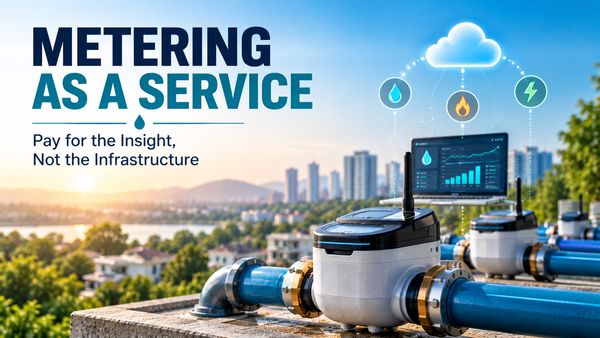
Most organizations do not want to spend their time owning and maintaining a metering system. They want reliable answers: how much water flowed through a pipe, how much electricity a facility used, or how much gas a process consumed. The meters, networks and software are the means to that end.
Metering as a Service (MaaS) brings these components together under a managed service agreement. Instead of purchasing every component and maintaining the entire system internally, an organization may subscribe to a service that delivers consumption data, monitoring and agreed operational support.
For water utilities, property operators and industrial facilities, this model can make digital metering easier to phase in. The right arrangement depends on the measurement requirements, connectivity, data integrations and responsibilities written into the contract.
Traditional metering deployments can create three recurring challenges.
Meters, gateways, communications infrastructure, software and installation may require substantial capital before the first useful reading arrives. For utilities, industrial sites and property developers, that investment can delay a project or restrict how quickly it expands.
A service model may spread eligible costs over a subscription period. However, compare the complete contract cost with the cost of buying and operating the system yourself; a subscription is not automatically cheaper.
Batteries eventually need attention, devices may require replacement, firmware needs updates and communications can fail in basements, pump rooms or meter pits. Someone must monitor these components and respond when something stops working.
A MaaS contract can assign defined maintenance and support responsibilities to the provider. Check the service-level agreement (SLA) carefully: confirm response times, uptime targets, replacement terms and which site visits are included.
Monthly or quarterly readings can leave leaks, equipment faults or billing discrepancies undiscovered for too long. More frequent data can help teams investigate unusual consumption earlier—but only when the system captures reliable readings and alerts reach someone responsible for acting.
Read more about leak detection using smart water meters and IoT monitoring.
| Consideration | Traditional ownership model | Metering as a Service |
|---|---|---|
| Cost structure | More costs may be paid upfront | Subscription or service fees may spread costs over time |
| Maintenance | Customer manages or contracts support separately | Provider responsibilities depend on the SLA |
| Data frequency | Depends on the meter and reading process | May include frequent telemetry and remote reporting |
| Upgrades | Customer plans and funds upgrades | Upgrade responsibilities must be defined in the agreement |
| Scaling | Additional deployment and integration work may be required | Modular expansion may be available, subject to contract and coverage |
| Control and exit | Customer controls its owned infrastructure | Data access, portability and exit terms need careful review |
The service label alone does not guarantee real-time data, lower costs or better uptime. Confirm what is included and validate performance at the actual deployment locations.
A metering service commonly brings together four layers.
Devices measure consumption or operating conditions. Depending on the application, these may include ultrasonic water meters, electricity submeters or gas meters designed for the relevant conditions.
For water applications, explore Aegir's Ultrasonic Precision Water Meter with Modbus and Ultrasonic Precision Water Meter with LoRa. These product pages describe the available communication options and specifications. Confirm model suitability against your site's flow range, installation conditions and integration requirements.
The communications layer sends readings to a gateway, control system or cloud platform. Depending on site conditions and device support, options may include wired Modbus/RS-485, LoRa-based networks or cellular connectivity.
Explore Aegir's communication and retrofit protocol converters when assessing ways to connect compatible legacy meters to a monitoring system.
Raw readings may need validation, normalization, storage and quality checks before they are suitable for reporting or integration. Ask how missing readings, duplicate records, device clock differences and communication outages are handled.
The service should make the data useful to the people who need it. This may include consumption dashboards, anomaly alerts, reports and billing-ready exports or integrations.
For water monitoring, Aegir's smart water management products provide a starting point for exploring available metering and monitoring hardware. Confirm separately whether your project requires a third-party cloud platform, managed operations, a billing integration or a full MaaS contract.
A managed smart metering deployment can help organizations monitor consumption more frequently, investigate continuous flow that may indicate a leak, identify missing readings and compare usage across locations or processes. It can also support better records for internal reporting and water-efficiency programmes.
MaaS can allow a rollout to proceed in stages rather than requiring every site to be upgraded at once. The deployment plan should still account for meter accuracy, communications coverage, data retention and the response process for alerts.
For further context, read Aegir's articles on smart water metering and IoT-driven smart water management systems.
For gas applications, the meter and installation must be appropriate for the gas, pressure, temperature, hazardous-area requirements and applicable local regulations. Depending on the system, corrected-volume readings, anomaly alerts and remote isolation may be relevant. Do not assume that a general-purpose metering platform or water-meter hardware is suitable for gas; verify the relevant certifications and safety requirements.
Submeters can help landlords, facility teams and industrial operators understand consumption by tenant, floor, building system or process. More granular data can inform allocation, reporting and energy-efficiency investigations. Integration with the existing building or energy management system should be assessed early.
Check performance across the expected operating range, including low flows where relevant. Ask for supporting test information, calibration procedures and the conditions under which published specifications apply. For gas, confirm that volume correction and safety requirements match the installation.
Request coverage evidence for meter pits, basements, pump rooms and other difficult locations. Define what happens when the primary connection fails, how readings are buffered locally and how missing data is reported.
An alert is useful only when someone knows what to do next. Agree on thresholds, notification routes, escalation times and responsibilities for events such as continuous flow, sudden spikes, zero readings, tampering or device offline status. Establish how false positives and unresolved alerts will be reviewed.
High-frequency sensor data can be much more detailed than the information an enterprise resource planning (ERP) system needs for accounting. Design the integration so that the metering platform manages raw telemetry and quality checks, while the ERP receives the validated summaries or transactions required by the business.
Also confirm API availability, integration costs, data export formats and who maintains the integration after launch.
Compare the full cost of the service over the proposed contract term with the cost of owning and operating the system. Include:
Ask who owns the devices and the data, how historical records can be exported, what happens if the provider changes its platform, and whether the service can be transferred to another supplier. A clear exit plan reduces the risk of being locked into an unsuitable arrangement.
As metering systems become more connected, they can support workflows that go beyond reporting. Depending on the hardware, controls and safety design, a deployment may trigger an investigation, control a pump or operate a valve when a defined condition is met.
Automation should be designed with suitable safeguards, permissions, manual overrides and failure handling. Do not rely on a consumption alert alone to make safety-critical decisions.
The broader shift is simple: organizations can focus less on maintaining instruments and more on using reliable measurements to improve operations. A well-designed MaaS arrangement can support that goal when the service scope, data quality, responsibilities and total cost are clear.
If your priority is water consumption monitoring, remote readings or identifying unusual usage, explore Aegir's smart water metering products. Review the Modbus ultrasonic meter and LoRa ultrasonic meter to understand the available options, then confirm the full system architecture and service responsibilities for your application.
Metering as a Service is a managed model in which a provider combines metering devices, connectivity, data processing and reporting under a subscription or service agreement, rather than requiring the customer to manage every component independently.
Potential benefits include lower initial capital requirements, more predictable operating costs, reduced maintenance burden, more frequent consumption data and easier scaling. The actual benefits depend on the contract, service levels and site requirements.
Smart water meters can provide consumption readings and connectivity options for a managed metering deployment. The selected meter, communications network, data platform and service provider must be checked for compatibility.
Confirm measurement accuracy, connectivity coverage, data frequency, alert ownership, service-level commitments, maintenance and replacement terms, data ownership, integration requirements, exit provisions and access to historical data.
No. MaaS changes how costs are funded and managed; it does not eliminate them. Compare subscription fees, installation, connectivity, integration, support, contract duration and exit costs against the total cost of owning and operating the system.
2026-05-22

2024-05-21


