2026-09-24
•
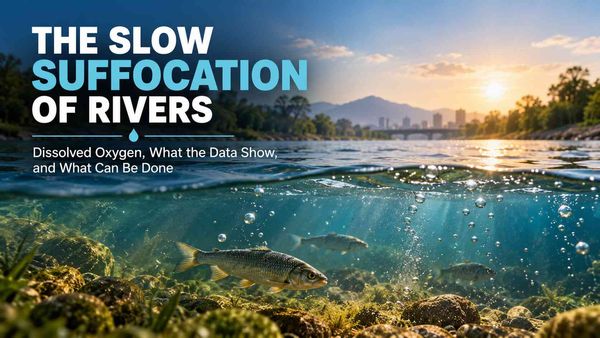
Dissolved oxygen (DO) is one of the most important indicators of river health. Fish, invertebrates, plankton and aerobic microorganisms depend on oxygen dissolved in water, while changes in DO can reveal shifts in temperature, organic loading, nutrient enrichment, flow and other river conditions.
The source article describes dissolved oxygen as a vital sign for rivers and examines global and Indian data on river deoxygenation, its ecological and social impacts, and measures that can help improve river health.
Dissolved oxygen is oxygen held in water and available for aquatic organisms to use for respiration. It is different from the oxygen chemically bound in the water molecule.
The concentration of dissolved oxygen in a river reflects a balance between oxygen supply and oxygen demand.
Oxygen enters water primarily through:
Water temperature, air pressure and salinity influence how much oxygen water can hold. Warmer water generally has lower oxygen solubility.
Oxygen is consumed by:
This is why dissolved oxygen can act as an integrated indicator of river conditions. When DO changes significantly, it can signal that conditions upstream or within the river have changed.
Adequate dissolved oxygen supports aquatic ecosystems and helps maintain normal biological and chemical processes in rivers.
When oxygen levels decline, aquatic organisms can experience stress. The source article notes that many freshwater fish experience stress below roughly 5 mg/L, while mortality can occur below about 2 mg/L, although tolerance varies considerably between species.
Low oxygen can therefore affect:
Aegir's article on Bengaluru's polluted lakes and water quality also discusses dissolved oxygen, nutrient pollution, algae growth and aquatic ecosystem health.
Low dissolved oxygen is usually the result of multiple interacting physical, chemical and biological processes.
Warmer water holds less dissolved oxygen. The source article identifies oxygen solubility and temperature as major factors in global river deoxygenation.
Climate-driven warming can therefore place additional pressure on rivers even when pollution loads remain unchanged.
For related climate and water-resource context, see Aegir's water overuse and climate change article.
Microorganisms consume oxygen while decomposing organic matter. When rivers receive high organic loads from untreated or partially treated sewage, oxygen demand can increase and DO can decline.
This makes effective sewage treatment a central part of improving river water quality.
Excess nutrients such as nitrogen and phosphorus can stimulate algal growth. When algae and organic matter decompose, microbial activity can consume substantial amounts of oxygen.
Aegir's discussion of polluted lakes, nutrient pollution and dissolved oxygen provides a related example of how these processes can affect aquatic ecosystems.
Nitrification consumes dissolved oxygen as microorganisms convert ammonia into other nitrogen compounds. The source article notes that approximately 4.3 mg of oxygen can be consumed per mg of ammonia-nitrogen oxidised.
Riffles, rapids and waterfalls can increase oxygen exchange between water and the atmosphere. Deep, slow-moving water has less natural turbulence and can therefore have lower oxygen replenishment.
The source article identifies short-term heatwaves and dam impoundment as additional factors associated with deterioration in river oxygen conditions.
Dissolved oxygen and biochemical oxygen demand (BOD) measure different aspects of water quality.
| Parameter | What it indicates |
|---|---|
| Dissolved Oxygen (DO) | Oxygen currently available in the water for aquatic organisms and chemical processes |
| Biochemical Oxygen Demand (BOD) | Oxygen microorganisms are expected to consume while breaking down biodegradable organic matter |
The source article notes that India's monitoring programme measures BOD alongside dissolved oxygen, pH, faecal coliform, total dissolved solids and other water-quality parameters.
BOD can therefore help indicate the potential for future oxygen depletion, while DO provides a direct measurement of oxygen availability at the time of sampling.
The source article cites a global assessment covering 21,439 rivers between 1985 and 2023, using Landsat observations, climatic data and approximately 3.4 million satellite images analysed with machine-learning methods. It reports sustained deoxygenation across a large share of the rivers studied.
According to the source, 78.8% of the rivers in the assessment experienced deoxygenation, with oxygen solubility and temperature identified as major drivers.
The article also highlights stronger deoxygenation in tropical rivers between 20°S and 20°N, including rivers in India, where warmer baseline conditions can leave ecosystems closer to oxygen-stress thresholds.
India's water-quality monitoring framework measures both BOD and dissolved oxygen among other parameters. The source article states that the National Water Quality Monitoring Programme covers more than 4,000 stations across rivers and other water bodies. It cites 2022–23 data from 4,736 sites, including 2,155 river locations.
The source also reports 296 polluted river stretches across 271 rivers in 32 states and union territories in that assessment, with classification based on BOD levels and five priority classes.
The same source notes an improvement in the number of polluted stretches compared with earlier assessments, while some stretches remained unchanged and a number of Priority I stretches continued to record very high BOD.
River deoxygenation affects more than fish. It can influence ecosystem chemistry, greenhouse-gas emissions, livelihoods and water-treatment requirements.
Low oxygen can suppress growth, reproduction and normal behaviour before severe oxygen stress or mortality occurs. Sensitive species can be affected before a visible fish kill takes place.
Under oxygen-depleted conditions, sediments can release bound phosphorus, potentially contributing to further algal growth and subsequent oxygen depletion.
The source article links river deoxygenation with greenhouse-gas supersaturation and notes that deoxygenated rivers can become methane sources.
Oxygen-limited river reaches can affect inland fisheries and the value of aquatic resources. The source also notes that anoxic water can be more challenging to treat because of compounds such as ammonia and manganese and potential disinfection by-products.
Improving dissolved oxygen requires addressing both oxygen demand and the environmental conditions that influence oxygen supply.
The source article places untreated and partially treated municipal sewage at the centre of the oxygen problem and highlights decentralised treatment as a potential approach for smaller towns where treatment capacity is limited.
Because nitrification consumes oxygen, controlling ammonia entering rivers can reduce oxygen demand. The source specifically recommends stronger attention to ammonia regulation.
The source article notes that CPCB has issued directions for industries on critically or severely polluted stretches, including requirements related to stricter discharge limits or zero liquid discharge.
Periodic sampling provides valuable information, but continuous monitoring can reveal short-term oxygen swings that may otherwise be missed.
The source article recommends reporting dissolved-oxygen trends directly, installing continuous sensors at critical stations and publishing sub-daily data openly.
Aegir's water monitoring solutions provide connected measurement technologies for water-management applications. For broader context, see Aegir's digitalization of water management using IoT.
River water quality is connected to activities throughout a catchment. Effective management therefore requires monitoring pollution sources, river flows, land use and water demand at basin scale.
Aegir's Kerala River Basin Plan article discusses integrated river-basin management, river-health monitoring, water quality and flood-warning technology.
Modern water management increasingly depends on reliable, high-resolution data. Connected sensors can help water managers move from occasional measurements toward continuous visibility.
Depending on the application, a smart monitoring architecture can include:
Aegir's smart water-management products include ultrasonic water meters, LoRa/IoT connectivity and water-level monitoring systems. These technologies can support water-resource monitoring and operational decision-making, while dedicated DO sensing should be selected where dissolved oxygen itself is the measurement requirement.
Aegir's District Metered Area (DMA) article also demonstrates how high-resolution monitoring can support water-network management, leakage detection and operational analysis.
A single water-quality sample provides a snapshot. Rivers, however, change throughout the day and across seasons.
Temperature, sunlight, flow, rainfall, organic loading and biological activity can all affect oxygen levels. Continuous or high-frequency monitoring can make these variations visible and help researchers and water managers understand when and where oxygen depletion occurs.
This is particularly relevant during:
Dissolved oxygen is more than a laboratory measurement. It provides a window into the physical, chemical and biological condition of a river.
The evidence presented in the source article shows why river monitoring needs to look beyond isolated pollution measurements. Temperature, oxygen availability, organic loading, nutrient enrichment, flow and human activity interact to determine river health.
Better data can support better decisions—from sewage-treatment investments and industrial controls to continuous monitoring and river-basin planning.
Dissolved oxygen is oxygen held in water and available for aquatic organisms such as fish, invertebrates and aerobic microorganisms. It is an important indicator of river ecosystem condition and water quality.
Low dissolved oxygen can result from warmer water, microbial decomposition of organic matter, nitrification, respiration, nutrient enrichment, reduced turbulence and other changes in river conditions. Heatwaves and dam impoundment can also contribute to oxygen decline.
Dissolved oxygen measures oxygen currently available in water, while biochemical oxygen demand (BOD) measures the amount of oxygen microorganisms are expected to consume while breaking down biodegradable organic matter.
Aquatic organisms depend on dissolved oxygen for respiration. When oxygen levels become too low, fish and other organisms can experience stress, reduced growth and reproduction, altered behaviour and, at very low concentrations, mortality.
River water quality can be improved through effective sewage treatment, industrial pollution controls, nutrient management, continuous water-quality monitoring, protection of river ecosystems and data-driven water-resource management.
Dissolved oxygen is one of the clearest indicators of river health. Declining oxygen can reflect warming water, organic pollution, nutrient enrichment, low flow and other changes in river systems.
The source article's global and Indian data highlight the importance of monitoring both present oxygen availability and the factors that create oxygen demand.
Improving river health requires effective sewage treatment, pollution control, continuous monitoring and integrated river-basin management. As water systems become more variable, high-quality data will be increasingly important for protecting aquatic ecosystems and supporting sustainable water management.
Looking to improve water-resource monitoring and data-driven water management?
Explore Aegir's smart water-management solutions and learn more about IoT-based water monitoring and digitalization.
2025-01-10

2026-08-27


