2026-08-27
•
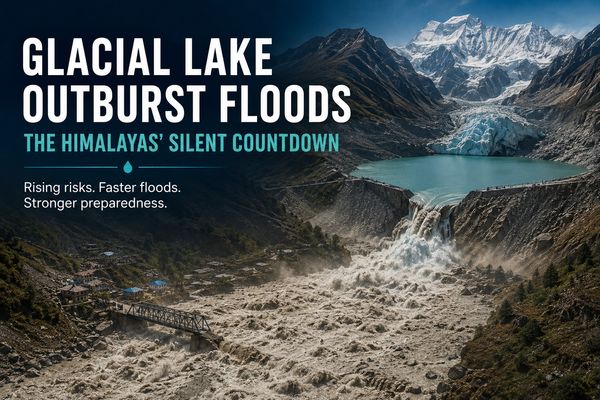
Glacial Lake Outburst Floods, commonly known as GLOFs, are sudden floods caused by the rapid release of water stored in a glacial lake. They can send water, sediment, rocks and debris through steep mountain valleys with little warning.
The Himalayas are particularly vulnerable because glaciers are changing rapidly, new glacial lakes are forming, and more roads, bridges, settlements and hydropower infrastructure are located downstream.
The article highlights major events in Sikkim in 2023 and Nepal in 2025, as well as a major flash flood in Nepal's Rasuwa district on 26 August 2026 that was suspected to be a GLOF. These events underline the importance of GLOF monitoring, early warning and disaster preparedness.
A Glacial Lake Outburst Flood (GLOF) occurs when a glacial lake suddenly releases a large volume of stored water.
Glacial lakes may be held back by natural barriers made from:
Unlike engineered dams, these natural barriers can be unstable. A landslide, avalanche, earthquake, intense rainfall or rapid lake changes can cause overtopping or failure.
GLOFs can combine:
The resulting flood can damage bridges, roads, homes, dams, hydropower facilities and other critical infrastructure.
Climate change is a major factor in the changing GLOF risk landscape. Rising temperatures can accelerate glacier melt, creating new glacial lakes and causing existing lakes to expand.
As glaciers retreat, meltwater can accumulate behind moraines or ice barriers. Larger lakes can mean greater volumes of water are available if a breach occurs.
A landslide or avalanche entering a glacial lake can displace water, trigger overtopping and weaken the natural barrier.
The Himalayas are seismically active. Ground shaking can destabilize moraine dams and surrounding slopes.
Sudden and intense rainfall can increase inflow into vulnerable lakes and contribute to flooding or slope instability.
Roads, bridges, settlements, dams and hydropower projects in mountain valleys mean that more people and infrastructure can be exposed to GLOF hazards.
For related climate and water-resource context, see Aegir's water overuse, climate change and sustainability article.
A major GLOF can affect:
Effective GLOF risk management begins with identifying vulnerable lakes and continuously monitoring relevant environmental conditions.
Monitoring can include:
Rainfall data can support flood and landslide risk assessment, particularly in mountainous terrain.
Aegir's Smart Rain Gauge article explains how remote rainfall measurement can support flood-related monitoring, agriculture and weather forecasting.
Aegir also offers a smart water level monitoring system for water-management applications. It can support broader monitoring deployments where its specifications are suitable, but it should not be presented as a standalone GLOF detection or warning system.
Because a GLOF can move rapidly downstream, warning time can be extremely limited.
A robust GLOF early warning system can combine:
Aegir's IoT-based water management article provides additional context on connected sensors, remote data and real-time monitoring.
In some high-risk locations, engineering interventions may reduce the amount of water available for a sudden outburst.
Possible approaches include:
GLOF risk should influence where infrastructure is built.
Hazard maps can help authorities identify exposed areas and inform:
Aegir's article on integrated river basin management and flood warning discusses the importance of monitoring and flood-warning technology in water-resource planning.
Technology only helps when communities know how to respond.
Communities downstream from potentially hazardous lakes need to understand:
Regular training and drills can turn an early warning into effective action.
Glacial lakes and river systems do not follow political boundaries. A GLOF originating in one country can affect communities and infrastructure downstream in another.
Effective cooperation can support:
IoT technology can support continuous environmental monitoring by collecting and transmitting data from connected sensors.
Depending on the application, monitoring systems can collect:
Aegir's connected water monitoring solutions include ultrasonic water meters, water-level monitoring and IoT technologies.
For another monitoring application, see Aegir's groundwater monitoring article.
A Glacial Lake Outburst Flood occurs when water stored in a glacial lake is suddenly released, often after failure or overtopping of a natural moraine or ice dam. The resulting flood can carry water, sediment, rocks and debris downstream.
Warming temperatures are causing glaciers to retreat and new or expanding glacial lakes to form. Landslides, avalanches, earthquakes and intense rainfall can further destabilize these lakes, while increasing development in downstream valleys can increase exposure.
GLOF risk can be reduced through systematic lake monitoring, hazard mapping, controlled drainage where feasible, multi-channel early warning systems, evacuation planning, safer infrastructure siting, community preparedness and cross-border data sharing.
Satellite observation, drones, water-level sensors, rainfall monitoring, ground-based sensors and communication networks can support risk assessment and early warning. Monitoring tools should be selected according to the hazard, terrain and local warning-system requirements.
Glacial Lake Outburst Floods are a serious and evolving hazard in the Himalayas. Climate-driven glacier change, expanding glacial lakes, unstable natural barriers and increasing downstream development can combine to increase potential consequences.
The risk can be reduced through sustained monitoring, hazard mapping, carefully designed engineering interventions, reliable early warning systems, safer infrastructure planning and well-prepared communities.
GLOF resilience is not a one-time project. It requires continuous observation, reliable data, effective communication and coordinated action.
Looking to improve remote water-level, rainfall or water-resource monitoring?
Explore Aegir's connected water monitoring solutions and learn how IoT-enabled sensing can support better water-management decisions.
2025-03-21
2026-09-24


